


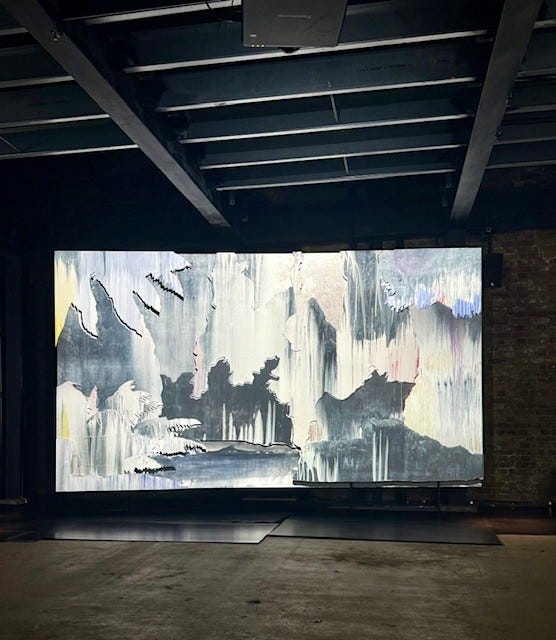
Last week, I stepped out for my usual mid‑morning coffee and noticed that an art exhibition had appeared beneath the railway arches behind my office. It was free, and curiosity won over caffeine, so I traded my coffee break for fifteen minutes of intrigue.
Inside, I found myself in a dimly lit, warehouse‑style space. Three large art scenes hung suspended in a triangular formation, each with a bench facing it. I chose a seat, leaned back against the cool wall, and fixed my eyes on the scene directly ahead.
As my vision adjusted, the landscape in front of me began to shift. A photographic projection dissolved into the scenery, the transition so fluid it felt almost organic. Nature sounds filled the room, the lighting shifted in gentle waves, and droplets of water fell steadily into a shallow puddle on the floor, punctuating the ambience with soft, echoing taps.
The exhibition was the work of Noémie Goudal. After researching hydrology and hydrogeology, she created a desynchronised interpretation of the water cycles she had studied - making visible, through colour and movement, the particles carried from one landscape to another.
I had wandered into this immersive world on a whim, knowing nothing about the artist or her intentions.
Sitting on the metal bench, trying to make sense of what I was seeing, my mind drifted. At first, I felt awkward - half adjusting to the darkness, half trying to understand the scene. Shadows emerged on the canvas, shifting slowly with the projections. The moment transported me back to childhood: lying awake at night, staring at the shapes cast across my bedroom walls, deciding whether they were harmless or a reason to run to my parents’ room. For a moment, I felt like that child again - curious and alert.
The seasons began to change before me. It was like watching a year unfold through a window in time‑lapse: day to night, warmth to frost, monochrome to colour. The canvas turned white as rain froze into a misty storm. The child in me resurfaced again, remembering the thrill of pulling back the curtains on a winter morning to find the world transformed.
As I settled into the exhibition’s rhythm, my thoughts shifted to something more recent. I had just finished reading Elif Shafak’s There Are Rivers in the Sky, a novel that left a deep impression on me. It explores the idea of water memory - the notion that water carries stories, histories, and connections across time. The book follows a single drop of water as it lands on the hair of a king, evaporates into the atmosphere, returns to a spring, travels to the open sea, rises again, and eventually becomes a snowflake that melts on the lips of a newborn baby centuries later. A cycle both ordinary and extraordinary.
Before reading it, I had never given much thought to the movement of water. Living in an area where our water network is frequently disrupted (this day being one of those times!) the topic suddenly felt more relevant, more personal.
Back in the exhibition, the scene in front of me shifted once more, from photographic realism to hyper‑colour abstraction. Bright streaks of colour traced the paths of water, revealing the invisible journeys of the world’s most essential resource.
What began as a spontaneous fifteen‑minute break became something unexpectedly meaningful. It reawakened childhood memories, echoed the wonder of a novel still fresh in my mind, stirred my concerns about our fragile water systems, and left me wanting to know more about the artist who had given me this brief but powerful escape from the working day. This is one of the reasons that I love art so much: its power to move the mind.
About the artist:
Noémie Goudal Is a graduate of the Royal College of Art, London and is based in Paris, France.
Oh, how I wish I had the ability to appreciate such art! You have made it come alive and (yes) even tempt me to travel to London to experience it for myself. It is wonderful that different people see, hear and sense different things when experiencing the same situation. And in particular how this exhibit has opened a memory channel for you, back to childhood. Such a thoughtful and well-expressed piece. Thanks, Claire.