


Read the full article - the truffle hunting, the medieval streets of Volterra, the private chef dinner, and one story I wasn’t expecting to find in the Tuscan hills — over on the blog: Dolce Far Niente in Tuscany: A Historic Tuscan Farmhouse Retreat
There is an Italian phrase: “Dolce far niente.” The sweetness of doing nothing. It sounds simple, but it’s something we are no longer used to.
When I turned fifty this spring, I had a choice to make. I could mark it with noise - a party, a crowd, champagne glasses clinking in a room full of people. Or I could do something else entirely. Something quieter.
I chose a hilltop farmhouse in Tuscany. I chose people I loved. I chose a week with no schedule and no agenda, where the main event was sitting at a marble table on a terrace, watching the light move across the valley below.
In everyday life, the mind is rarely still. There is always something pulling at the edges of attention - the next task, the next notification, the low hum of a world that never quite goes quiet. Pascal wrote, in 1670, that “all of humanity’s problems stem from man’s inability to sit quietly in a room alone.” It is a striking thought - that restlessness isn’t a modern invention, that the struggle with stillness is as old as human nature itself.
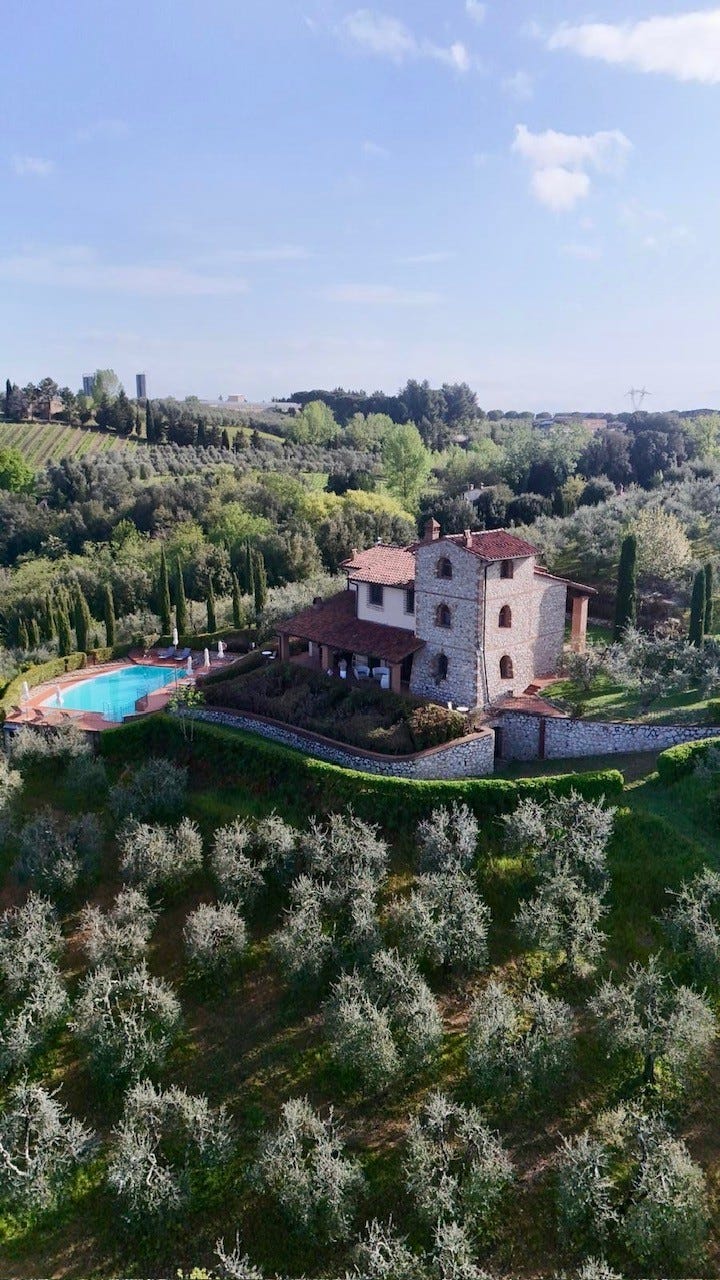
The hilltop in Italy offered time out of life, but was full of life. It looked like this: an ancient stone farmhouse built around a medieval tower, olive trees leaning into the late-afternoon light, and a valley so still that the distant Alps felt like a painting rather than real. It looked like pizza made on the barbecue - imperfect, smoky, shared - because someone suggested it, and it felt exactly right. It looked like cantuccini dunked into dessert wine at the end of a long evening watching the swallows fly circuits around the vineyard. It was very little, done extraordinarily well.
The days had a quality I had almost forgotten was possible. A family breakfast drifting into mid-morning coffee. Lunch unhurried. Evenings that unfolded slowly, with the kind of ease that only happens when no one has anywhere else to be. Time stopped asking anything of us, and we stopped asking anything of it.
This is what dolce far niente actually means - not the absence of activity, but the absence of obligation. Not emptiness, but a fullness of a different kind. The Italians have understood, for a very long time, that the quality of a life is not measured by its output. That some of its most important moments are the ones where nothing, technically, happens.
We made the most of the week - truffle hunting in the Tuscan hills, an afternoon in the medieval streets of Volterra, a final evening with a private chef and a table decorated with antique lace. But what I will carry longest is something harder to photograph. The particular silence of a hilltop at dusk and the way a good conversation slows when no one is watching the time.
Pascal saw what stillness costs us to achieve. Italy simply offers the alternative - not as a grand gesture, but as an everyday practice, stitched into the culture like the pattern on a tablecloth. The long lunch isn’t inefficiency. The evening passeggiata isn’t an indulgence. They are the quiet enjoyments of life that allow us to breathe to see what’s important in life.
The sweetness of doing nothing, it turns out, is one of the hardest things to learn. And one of the most worth knowing.
Read the full blog at journeyincolour.com